In time, precious textiles, furs, and ornaments moved by long,
difficult overland trade routes or hazardous water voyages. Later,
textile centers evolved where people demanded large quantities of luxury
fabrics and were willing to pay well for them. Byzantium, as well as
Sicily, produced fine silks during the Middle Ages, although they were
far from the original sources of silk. Even so, proximity of raw
materials gave some geographic areas advantages over others. Certain
districts in Italy, Germany, Flanders, and England became textile
centers, specializing in locally produced fibers and distinctive
techniques. In medieval times, traveling merchants transported fine
textiles from production centers to regional trade fairs on a regular
basis.
The ramifications of trade in textiles and other apparel materials
extended far beyond the obvious. In ancient Mesopotamia, the need to
record exchanges of these and other goods stimulated development of
counting systems and writing. Eventually, coinage evolved to expedite
transactions. Still later, Italians pioneered bookkeeping, banking, and
legal systems to facilitate and organize international commerce.
The great plague, the Black Death, which killed as many as one-third
of the people in Europe, may have reached Europe from Asia in the
middle 1300s, transported by infected fleas on furs carried by caravans
along the ancient silk road. As the plague abated, fashion change
accelerated because of greater concentration of population in cities,
shifts in the distribution of wealth, and growing importance of
commercial life. The demand for furs in the sixteenth century, including
beaver skins to make fine felt hats, became a major force driving the
exploration of North America. Remote Australia and New Zealand were
settled largely because sheep could be raised profitably there.
Guilds
In the Middle Ages and Renaissance, members of guilds produced
elegant and costly clothing to order for wealthy and high-ranking people
on the European continent. Guilds were part civic associations, part
trade associations, part labor unions. Guilds specialized in certain
crafts ranging from hats to shoes. Membership was strictly controlled;
new members served long apprenticeships and had to meet strict criteria
for admission. Detailed rules served to uphold quality of production and
limit competition. In general, men dominated the guilds; women did
certain specialized tasks such as embroidery but had little role in
governance. Not until the late 1600s, as guilds were ebbing in power,
was the first guild controlled by women, the mantua makers, officially
recognized in France.
National Pride and Profit
Nations have long promoted fashions to stimulate demand for their
products. In the 1600s, King Louis XIV displayed the beauty of French
silks and laces by wearing them and dictating that members of the French
nobility also showcase French products. France sent dolls dressed in
the latest fashions to other nations to create desire for French goods
among the upper classes. According to Mr. Pepys' diary, Charles II of
England introduced a subdued style of men's clothing in England in 1666,
partly to promote English wool and linen fabrics.
The Concept of Fashion
"Fashion" is a complex concept, but economic analyses require
simple, operational definitions. Therefore this essay uses definitions
based on those stated by Paul Nystrom in his 1928 book, Economics of
Fashion. He defined "style" as "a characteristic or distinctive mode or
method of expression in the field of some art" (p. 3) and "fashion" as
"the prevailing style at any given time" (p. 4). A source of confusion
is that the word "fashion" can be used to mean either "content" or
"process."
In writing or speech, the word "fashion" is often misused as a
synonym for women's clothing. Yet most consumer goods and services are
subject to the fashion process. Fashion also affects noneconomic matters
such as social customs. The economic structure of consumer goods
industries reflects the role of fashion, which in turn indirectly
affects basic industries. Because "fashion" can involve virtually all
aspects of contemporary life, this essay concentrates on the economics
of clothing.
"Demand" is not a quantity; it is the relationship between prices
and how much consumers are willing to buy at various prices. If demand
for a commodity is great, people will generally buy larger amounts of it
at various prices than they will buy if demand is small.
The Origin of Ready-to-Wear
During the reign of Charles II, according to Beverly Lemire, the
ready-to-wear clothing industry originated when shipowners or the
British navy ordered plain, coarse garments in quantity to outfit crews
of English ships heading to sea on voyages lasting months or years.
There were as yet no garment or textile factories in the modern sense.
Garment production was controlled by (mostly) men who contracted with
the government or shipping companies, bought materials in quantity and
then hired workers who took the supplies home with them to make the
garments by hand. Workers were paid by the unit, and the contractors
often cheated them. The system of subcontracting clothing production
continues today.
Mechanization of Production

Although production of ready-to-wear clothing began before sewing
machines existed, an English clergyman had invented a hand-operated
knitting frame near the end of the sixteenth century. Queen Elizabeth I
refused to grant him a patent because she feared it would put English
hand-knitters, using knitting needles and mostly working at home for
contractors, out of work. But by the eighteenth century, England led the
industrial revolution with a stream of inventions that eventually
reduced prices of many goods and improved their quality so that ordinary
people could afford them. By the later 1700s, English factories were
turning out fabric on water- or steam-powered spinning and weaving
equipment. Demand for inexpensive clothing gradually increased in
England as lower-class people, some of them employed in the new
factories, began to have a bit more money to spend, as well as a growing
interest in fashionable clothing. London stores began to display
appealing merchandise in lighted shop windows and encouraged shopping as
recreation. Even low-income people could buy small ribbon ornaments and
other accessories (See McKendrick, Brewer, and Plumb).
Meanwhile, clothing styles of English noblemen became simpler and
more functional as they supervised agricultural activities on their
estates rather than hanging around the royal court, as was the case in
France. French noblemen copied English styles when the French Revolution
made it dangerous to be seen in public wearing silks and laces.
By the early nineteenth century, workingmen's clothing was being cut
and hand-sewn by workers who specialized in specific tasks rather than
each making a garment from start to finish. In American coastal cities,
workers constructed garments for sailors in lofts where sails were made,
from the same sturdy materials. Inventors designed the first sewing
machines, but handworkers, who feared losing their jobs, broke up the
machines, which didn't work very well anyway. Improved versions soon
followed; the 1800s brought numerous apparel-related inventions and
discoveries, including shoemaking machinery, vulcanized rubber,
artificial cellulosic fibers, and synthetic coal-tar dyes.
Wars such as the American Civil War created demand for large
quantities of uniforms. Based on measurements of servicemen,
standardized sizing of men's clothing evolved. By the later 1800s, men's
factory-made clothing of reasonably good quality and fit was being
produced in quantity. Although wealthy men still wore custom-made
clothing, moderate-income men could dress better than ever before.
The situation for women's clothing differed from that for men's
clothing. Styles were relatively simple in the later 1700s and early
1800s, but then outfits became increasingly ornate and complex and
remained so for the rest of the nineteenth century. This complexity,
plus lack of measurement data for women, delayed large-scale factory
production of women's clothing. Late in the century, when
separates-shirtwaist and skirt styles and tailored women's suits-became
fashionable, it was easier for women to find ready-made clothing to fit.
By the end of the 1800s, output of women's factory-made clothing was
growing rapidly.
Paris Couture
Although wealthy people still wore custom-made clothing in the
1800s, the guilds were gone by the time Charles Worth, ironically an
English immigrant to Paris, opened the first couture house in the
mid-nineteenth century. The Paris couture, offering exclusive new styles
for women to be made-to-order each season, reached its peak volume in
the late 1800s and early 1900s. Only the richest women could afford
couture apparel, and volume was never large, but the couturiers were
masters of publicity. Actually, the practice of holding well-publicized
"showings" of new fashions each season originated in England not with
clothing designers but with such enterprising businessmen as Josiah
Wedgwood, who in the late eighteenth century invited well-to-do
customers to seasonal openings of his latest designs in tableware and
decorative ceramics (See McKendrick, Brewer, and Plumb).
Fashion for Everyone
With the help of fashion magazines, which originated in the early
1800s, and paper dress patterns for home sewers, introduced later in the
century, seamstresses copied or adapted couture designs for
middle-class clientele far from fashion centers. In America, some
dressmakers traveled from household to household twice a year, spending a
couple of weeks making new clothes for all females in a family.
Electric-powered sewing machines were installed in factories, but home
sewers and dressmakers used machines with foot treadles so they were not
dependent on electricity.
The first department stores opened in major cities in the United
States and Europe in the mid-1800s, with clothing as a major category of
merchandise. Instead of bargaining with customers over selling prices,
as small shopkeepers did, department stores began putting price tags on
their goods. Retail magnates such as B. Altman, John Wanamaker, and
Marshall Field built palatial stores to dramatize shopping as
recreation. Streetcar transportation, first horse-drawn and later
electric-powered, brought customers downtown. Smaller stores
specializing in men's or women's apparel, children's clothing,
undergarments and lingerie, or shoes, profited from customer traffic
attracted to city centers by big stores.
Catalog order firms such as Sears, Roebuck originated in the 1800s
as postal service and railroads developed in the United States. Mail
order made ready-to-wear clothing available to rural and small-town
residents. The first outlying shopping centers opened in the second and
third decades of the twentieth century, as automobiles multiplied;
Sears, Roebuck opened its first retail store in an early shopping
center. After World War II, building of suburban branches of large
department stores and major regional shopping centers accelerated,
leading to the decline of downtown shopping and the closing of many
central city stores. Giant regional shopping centers capitalized on the
entertainment aspect of shopping and consumers' seemingly limitless
appetite for variety.
Competition for Consumers' Money
Accelerating competitive trends in the apparel business has been the
gradual decline of clothing's share of total consumer spending. What
limited records survive show that during the Middle Ages and Renaissance
in Europe, in the heyday of the guilds, rich people spent huge
proportions of their incomes on luxurious clothing for themselves.
Furthermore, the nobility outfitted the various ranks in their
households, even down to the lowest servant, in appropriate styles and
the manor's heraldic colors for specific festivals or occasions.
Once, there were only limited ways to spend money to demonstrate
one's wealth-what Thorstein Veblen named "conspicuous consumption." In
the past 150 years, factory production has made clothing for ordinary
people less expensive, while many appealing new products have become
available: phonographs and parlor pianos, household appliances-including
sewing machines- motor vehicles, and electronic goods, starting with
telephones and radios. All of these impressed people's friends and
rivals, competing with clothing for the consumer's money. Of every
twenty dollars Americans now spend, only about one goes for clothing.
Simultaneously, long-term fashion trends, dating back at least to
Charles II of England in the 1600s, have moved toward ever-simpler,
less-formal, more casual clothing even for people in the upper ranks of
society. As more women work outside the home, fewer of them dress to
showcase their husbands' wealth and prosperity, as they might have in
Veblen's world. Demand for men's tailored clothing declined in the later
twentieth century, as did the number of specialty stores selling men's
clothing, as men chose more casual clothing and active sportswear.
Growing Ferocity of Competition
Couture was not profitable after World War I; its client base
dwindled further during the Depression of the 1930s. Designers tried to
control copying of their designs and sometimes produced lower-priced
replicas of their own exclusive models. Design piracy has long been a
plague for clothing manufacturers and designers, but no tactics seem to
stop it, especially when consumers are eager for the latest fashions at
the lowest possible prices. The spending of fickle teenaged customers,
anxious to look like popular entertainers, accelerates the pace of
fashion change.
For a time after World War II, couture houses licensed their names
to other firms to produce lower-priced clothing merchandise and
accessories. Some ventured into men's wear, with limited success. In
Europe and North America, the number of establishments producing fine
custom-made clothing and the number of customers that bought it had
declined. Demand continues to shrink for complex and costly custom-made
apparel such as elaborately embroidered or beaded garments. To the
extent that such clothing is still produced, production moves to India
and other Asian countries.
By the late twentieth century, large European corporations, some
outside the apparel business, competed to buy Paris couture houses and
leading Italian design firms, while other high-end design houses gobbled
up each other. Sales of expensive apparel and luxury accessories to
wealthy people and entertainers all over the world burgeoned in the
1990s' economic boom. Designer-name firms outdid each other by opening
showy retail stores, designed by avant-garde architects, in major cities
around the world, but some of these stores attracted more lookers than
purchasers and soon closed. Young design-school graduates from England,
Belgium, New York, California, and elsewhere started their own small
firms; only a lucky few achieved enough recognition or financial backing
to stay in business.
A Low-Paid Workforce
Clothing workers have always been poorly paid. Clothing for serfs
and servants on medieval estates was produced on-site, usually from
materials grown, harvested, and processed by serfs-essentially, slave
labor. Slaves made their own clothing on American cotton plantations.
Clothing production prospers where cheap labor is plentiful. Although
some operations require great skill, most construction tasks are divided
into small steps that can be learned quickly. In the past 200 years,
garment factories have been among the first large-scale manufacturing
enterprises to open in developing nations. In nineteenth-century New
York, manufacturers crowded hundreds of poorly paid immigrants into
high-rise buildings, often in unsafe situations. Contracting and
homework were widespread. One group of immigrants after another supplied
the labor-German, Irish, Jewish, Italian; in the twentieth century,
Puerto Ricans, Chinese, and Blacks joined the list. Even today,
"sweatshops" owned by and employing immigrants from Asia flourish in New
York City. During the second half of the twentieth century, garment
manufacture spread to Hong Kong, then to China and other parts of
southeast Asia, not to mention Latin America and African locations that
have large numbers of people willing to work for low wages. Although
machines facilitate clothing construction, much of the process resists
automation. Reading clothing labels is a lesson in geography.
Factoring
A longtime practice in the fashion industry is "factoring," whereby a
company takes out short-term loans to buy fabrics and other materials
to produce garments for the season, then repays the loans as retailers
purchase the goods. The specialized lenders are called "factors."
Factoring is not limited to apparel production; it also exists in other
industries where fashion changes quickly, such as toys. A plague of the
fashion business is that retailers squeeze manufacturers by returning
unsold goods or paying less than the agreed-upon price. Because the
garment business is so competitive, profits are low and existence is
risky.
The Used Clothing Trade
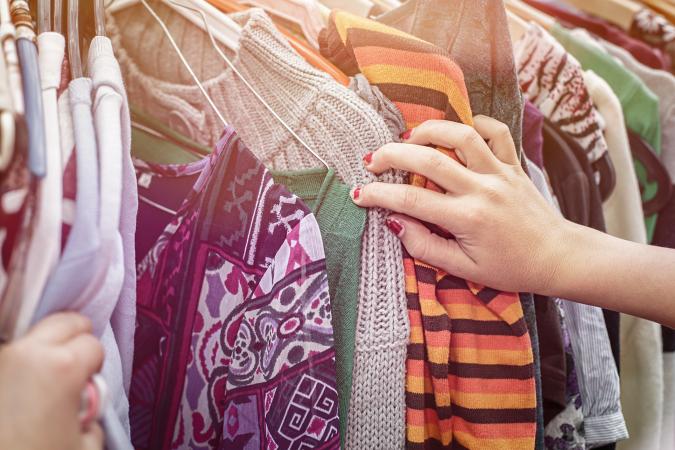
Trade in secondhand clothing has been important for many centuries.
Once wealthy and high-ranking people gave their unwanted clothing to
servants. Usually, servants sold the garments-they had no use for them
and needed the money. Patrons of theatres such as Shakespeare's Globe
donated clothing to actors who could not otherwise afford credible
costumes when playing high-ranking characters. Used clothing, including
stolen items, was sold by peddlers alongside crude, early ready-to-wear.
In the nineteenth century, the first factory-made garments were
sometimes introduced by secondhand clothing retailers. Stores selling
both used and new clothing (including military surplus) existed until
after World War II. Postwar, "yard" and "garage" sales became common,
apparently inspired by such sales on military bases, especially when
officers' families had to move to totally different climate zones.
Consignment shops, operated by charitable organizations or private
entrepreneurs, multiplied.
As the quantity of discarded clothing in Europe and North America
exceeded the capacity of welfare agencies to distribute it to the poor,
large quantities of used clothing have been shipped to developing
nations. In Africa, inexpensive used clothing can displace traditional
apparel and compete with local industries. At the other extreme,
"vintage" clothing-used couture or high-fashion women's clothing-has
become so popular and acceptable that leading Hollywood actresses may
wear old designer gowns to the Academy Awards ceremonies. Exclusive
auction houses sell vintage designer clothing for high prices; retail
stores in New York and Los Angeles specialize in such clothing.
Continuing Change
The garment business consists of all sizes of firms from giant to
tiny. Although the trend is giant companies, these are not assured of
success. Large corporations manufacture clothing under many labels. Some
famous brand names produce different qualities of clothing for
different types of retailers, contracting out production of some
merchandise lines to other corporations. Major producers can go bankrupt
unexpectedly; failure lurks just around the corner due to shifting
customer tastes and a variety of other uncertainties. International
trade regulations, tariffs, and quota systems engage the services of a
corps of lawyers and other specialists.
Everything changes quickly in the apparel world. Cities of developed
nations are littered with abandoned factories, empty retail stores,
defunct design houses, and wreckage of supporting industries.
Once-famous department stores are now history; Montgomery Ward is nearly
forgotten; Sears Roebuck slips in importance. Someday Wal-Mart may fade
away. As more shopping centers and big-box stores open, downtowns and
old shopping centers die. Everyone in the business knows that there is
too much retail space, yet they keep building stores. Change is the only
certainty.
The next phase in clothing distribution may be the Web, whether
goods are sold by conventional retail stores, catalog retailers,
Web-based retailers, or something completely different. Auction sites
such as eBay offer vintage clothing and also help manufacturers and
retailers trade large quantities of materials and clothing among
themselves.
See also Department Store; Fashion Industry; Globalization; Labor Unions; Mantua; Ready-To-Wear; Retailing; Anthropology of Secondhand Clothes; History of Secondhand Clothes; Sewing Machine; Sweatshops.
Bibliography
Benson, Susan Porter. Counter Cultures: Saleswomen, Managers, and Customers in American Department Stores, 1890-1940. Champaign: University of Illinois Press, 1988.
Cobrin, Harry A. The Men's Clothing Industry: Colonial Through Modern Times. New York: Fairchild Publications, 1970.
Cooper, Grace Rogers. The Sewing Machine: Its Invention and Development, 2nd ed. Washington, D.C.: Smithsonian Press for the National Museum of History and Technology, 1976.
Cray, Ed. Levi's. Boston: Houghton Mifflin, 1978.
Danish, Max D. The World of David Dubinsky. Cleveland: The World Publishing Co., 1957.
DeMarly, Diana. The History of Haute Couture, 1850-1950. New York: Holmes & Meier, 1980.
Frick, Carole Collier. Dressing Renaissance Florence-Families, Fortunes, and Fine Clothing. Baltimore: Johns Hopkins University Press, 2002.
Hansen, Karen Tranberg. Salula: The World of Secondhand Clothing and Zambia. Chicago: University of Chicago Press, 2000.
Helfgott, Roy B. "Women's and Children's Apparel." In Made in New York: Case Studies in Metropolitan Manufacturing. Edited by Max Hall. Cambridge: Harvard University Press, 1959.
Hendrickson, Robert. The Grand Emporiums. New York: Stein and Day, 1979.
Kirke, Betty. Madeleine Vionnet. San Francisco: Chronicle Books, 1998.
Lemire, Beverly. Dress, Culture and Commerce: The English Clothing Trade Before the Factory, 1660-1800. New York: St. Martin's Press, 1997.
Lockwood, Lisa. "Mega-Merger Mania: The New Blueprints of Five Ravenous Firms." WWD 186, no. 36 (2003): 1, 6-7.
McKendrick, Neil, John Brewer, and J. H. Plumb. The Birth of a Consumer Society: The Commercialization of Eighteenth- Century England. Bloomington: Indiana University Press, 1982.
Nystrom, Paul H. Economics of Fashion. New York: The Ronald Press Company, 1928.
Rexford, Nancy E. Women's Shoes in America, 1795-1930. Kent, Ohio: Kent State University Press, 2000.
Sandars, N. K. Prehistoric Art in Europe, 2nd ed. New York: Viking Penguin, 1985, pp. 49-50.
Spufford, Peter. Power and Profit: The Merchant in Medieval Europe. New York: Thames & Hudson, Inc., 2003.
Thorstein Veblen. The Theory of the Leisure Class. New York: Macmillan, 1899. Reprint, New York: The Modern Library, 1934.
Walker, Richard. Savile Row: An Illustrated History. New York: Rizzoli International, 1989.
Winakor, Geitel. "The Decline in Expenditures for Clothing Relative to Total Consumer Spending, 1929-1986." Home Economics Research Journal 17 (1989): 195-215.


cool keep going this website is very useful for me
ReplyDelete